
Westmoreland City Directory Shelves
Westmoreland County has a real, but uneven, city-directory shelf rather than one complete county list. The Greensburg Hempfield Area Library Pennsylvania Room is the strongest confirmed local source. Its holdings separate Greensburg microfilm from printed volumes and from the later Greensburg and Latrobe run. The collection page does not give every publisher or every issue year, so the title page of the volume in hand is the place to record those facts. A directory title may serve a city, a combined service area, or a publisher's circulation territory. Treat its geographic scope as a limit, not an assumption about the whole county.
| Collection | Years | Where Held | Access |
|---|---|---|---|
| Greensburg directories on microfilm | 1909-1959, intermittent | GHAL Pennsylvania Room | In-library or requested access; call 724-837-5620 |
| Printed Greensburg directories | Earliest 1913; intermittent 1927-1992 | GHAL Pennsylvania Room | In-library use; verify publisher and volume year on title page |
| Greensburg and Latrobe directories | 2000-present | GHAL Pennsylvania Room | In-library use |
| Wiggins' directory of Greensburg and Westmoreland County | 1890-91 | University of Pittsburgh Digital Collections | Free digitized volume |
Missing years matter. Intermittent holdings can explain why a surname disappears between two available issues. A gap may reflect the library's run, the publisher's coverage, or a household that was never included. Record what was searched, including the exact title and year, rather than turning an absent entry into a claim that a family had left Westmoreland County.
GHAL's Pennsylvania Room genealogy page describes the local directory and census research setting.
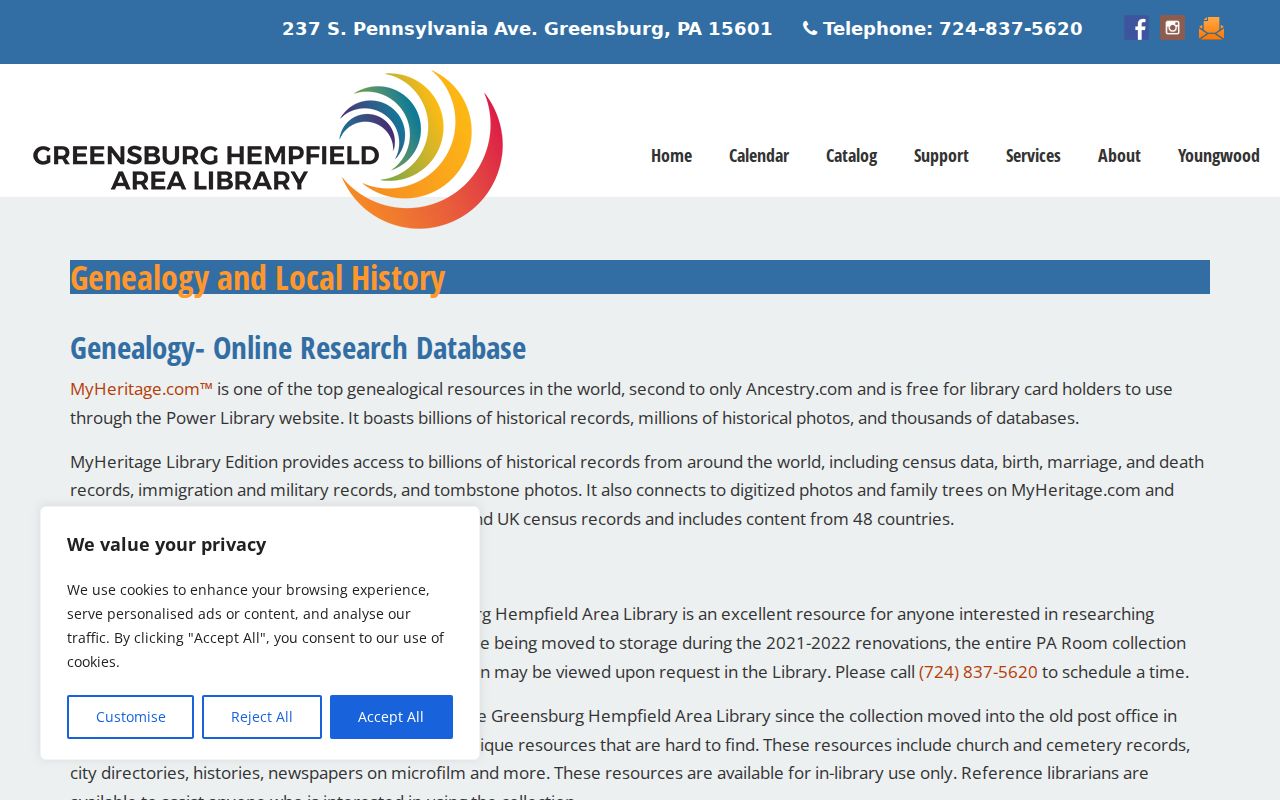
The Pennsylvania Room is the practical starting point for a specific Greensburg volume, especially when a printed issue has no online scan.
Greensburg's Intermittent Directory Years
The useful question is not simply whether a city directory exists. It is whether the Pennsylvania Room holds the year that falls between two other records. Its Greensburg microfilm begins in 1909 and reaches intermittent years through 1959. The printed Greensburg material begins with 1913, then has intermittent coverage from 1927 through 1992. The later printed Greensburg and Latrobe material begins in 2000. Calling first to reserve Pennsylvania Room access avoids treating a broad date range as a promise of every annual issue.
For an address trail, copy the heading and any locality named by the volume before searching the names. A Greensburg entry cannot automatically settle a question about a different Westmoreland municipality. The county includes 65 municipalities, and historical publishing boundaries can be narrower or wider than today's municipal lines. County GIS historic maps, including municipality-birth mapping, can help interpret an old place name before it is compared with a modern address.
Note: A title's service area and the library's intermittent run are both collection limits that should be preserved in a household research log.
Westmoreland City Directory in 1890
The digitized Wiggins directory offers an earlier formal entry point for Greensburg and Westmoreland County. Its catalog identifies an 1890 Greensburg publication of 455 pages and does not name a publisher. The title describes an alphabetical list of Greensburg inhabitants with names, occupations, and residences, followed by a township taxpayer list with assessed real-estate and personal-property values. Those figures are historical assessment context. They do not state a present value, prove occupancy, or replace a deed or census record.
The University of Pittsburgh's digitized Wiggins volume makes the 1890-91 directory available online.
The volume supplies an early local name, occupation, residence, and taxpayer layer that can be compared with later library holdings.
Reading Westmoreland City Directory Entries
No local directory page was opened during the source inspection, so a literal sample line or a particular publisher's shorthand should not be made up. Instead, capture the evidence in each volume as printed. A city directory entry can be a strong lead, but its fields vary by year and publisher. Preserve the page image or citation along with the entry. That lets a later reader distinguish a real abbreviation from an assumption and see whether a spouse notation, business line, or street address was actually present.
| Title, publisher, and year | Identify the exact volume before comparing it with another issue. |
|---|---|
| Geographic scope and page | Record the place covered by the title and the printed page holding the entry. |
| Exact name and street | Copy the line as printed, including initials, suffixes, and address wording. |
| Spouse and occupation | Note either field only when the entry prints it; both can separate people with the same name. |
| Abbreviation key | Photograph or transcribe the key from that volume before interpreting marks in an entry. |
- City directory
- A published locality-based listing that may organize people, businesses, or addresses for a particular service area and year.
- Criss-cross directory
- A reverse directory arranged by street or address. No confirmed Westmoreland County criss-cross run was identified, so do not presume one appears in a local volume.
- Householder index
- An index organized around the person treated as the household reference, rather than a complete list of every resident.
- Abbreviation key
- The volume's explanation of shortened terms and marks. Its meaning belongs to that edition, not automatically to another publisher's book.
When a directory uses a residence mark or lists a business address, compare it to the title's instructions and another independent source. A postal or business address can be useful, yet it is not a complete household roster.
Westmoreland Telephone Directory Layer
Telephone books add a separate layer to city-directory research. The Library of Congress describes its 1943-1950 Greensburg and Nearby Communities Telephone Directory reel as a Bell Telephone Company of Pennsylvania publication. Its listed issues are 1943, 1944, 1945, 1946, 1947, 1949, and 1950, and its coverage names communities from Delmont and Derry to Latrobe, Mount Pleasant, Youngwood, and Yukon. It is a telephone-directory source, not a substitute for the GHAL city-directory shelf.
The inspected white pages can show a surname, given name or initial, optional title, an r residence marker, street or rural-delivery address, and telephone number. Business and professional lines may add a business name, address, number, or occupation line. They do not reliably identify every household member, prove physical occupancy, or supply a complete county population. Compare a phone-book entry with adjacent available issues, a GHAL directory, census material, and the deed trail.
Tracing Westmoreland Directory Households
A household trail is strongest when it moves in short, dated steps. Start with the first available issue that plausibly covers the surname or address. Then follow the same name, street, and spouse or occupation clues through adjacent available volumes. The sequence can show a move, a changed business line, or a surname shift that deserves more checking. It cannot by itself settle why a person vanished from the listings.
- Find the earliest available directory entry and save the exact title, year, page, name line, and geographic scope.
- Check adjacent available directory years, noting only printed changes in name, street, spouse notation, or occupation line.
- Pair the last directory before a census with the next available federal census film at GHAL, then repeat after the census year.
- Use GHAL newspaper microfilm and its 1866-1900 death-notice collection when a disappearance needs a dated family-history lead.
- Test an estate or deed connection with the proper Westmoreland County custodian before identifying an heir or owner.
GHAL holds county census microfilm for selected 1790-1880 years and for 1900-1930, as well as the 1950 census. The national 1890 schedules were destroyed, so that gap cannot be repaired by searching the room's film. Church and cemetery records, local histories, old newspapers, and the two-volume 1771-1839 wills and letters index can supply a next source when census film is absent.
Note: A missing listing may reflect intermittent holdings or directory scope, so test it against a census, newspaper, deed, or estate record.
Pollins' Westmoreland Research Service
The Calvin E. Pollins Memorial Library is a separate, noncirculating resource at the Westmoreland History Education Center in Historic Hanna's Town. It reports more than 5,000 historical reference books, genealogical records, and original local documents. The library is open Thursday through Saturday, 10 a.m. to 4 p.m., is free to use, and charges $0.25 per photocopy. Visitors sign in, leave bags at the desk, use pencils, notepads, or laptops, and keep food and drink out of the research space.
Its written genealogy service covers people and families within the present Westmoreland County boundaries from 1773 forward. A request uses the Society's form, describes the person or surname and sources already consulted, and includes an authorized budget. The stated turnaround is about six to eight weeks. The first hour costs $30 and later hours cost $25, with at least one hour paid before work begins. Up to ten copies are included; courthouse deed or will copies and large patent maps have separate stated charges.
The Historical Society's Pollins Memorial Library page describes the research room and written-service terms.
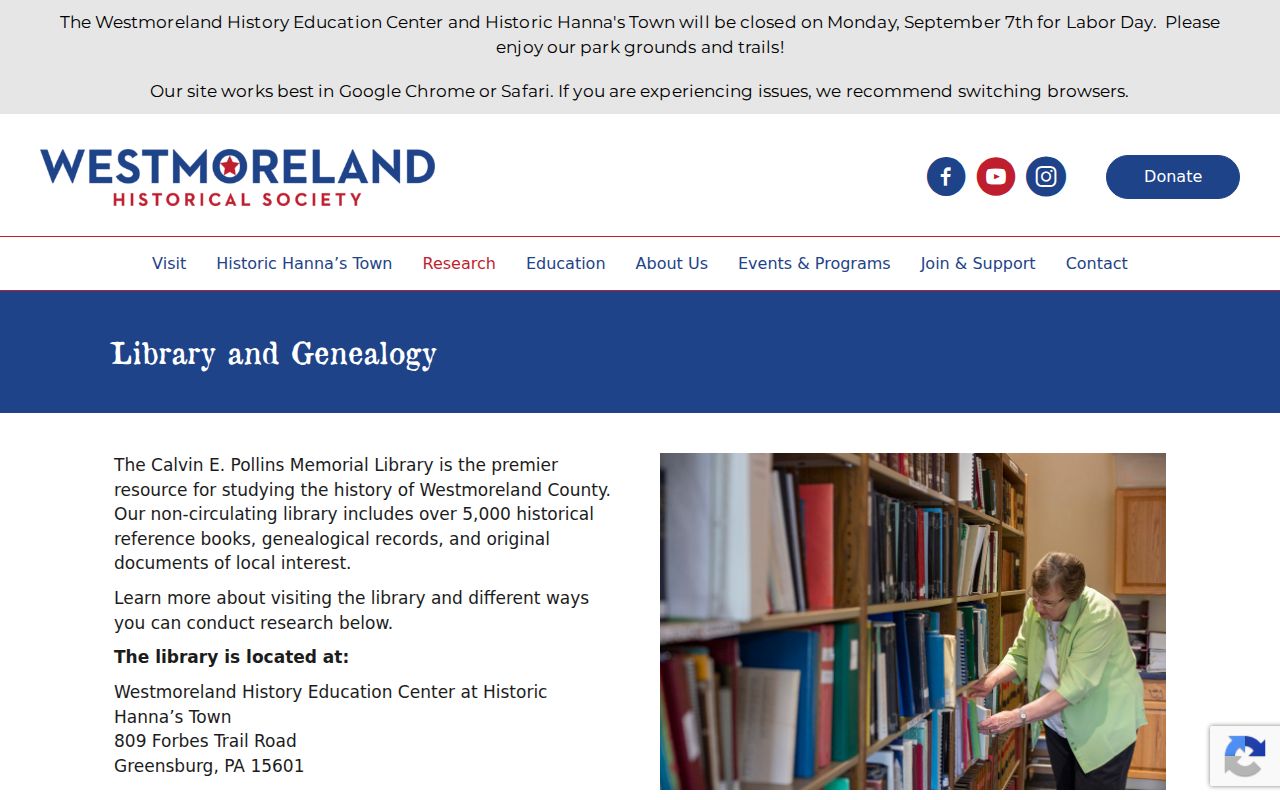
Pollins is a useful fallback for a surname or family question when an in-person visit to the directory shelves is not possible.
Westmoreland Archive Shelf Beyond Books
Historical directory work often needs a second local collection. The Westmoreland Historical Society archives accepts project-focused research by appointment and holds photographs, correspondence, organization minutes and records, unpublished documents, pamphlets, and publications from the eighteenth through mid-twentieth centuries. County GIS also supplies historic maps, cemetery maps, patent-owner maps, a 1790 county map, a frontier map, and municipality-birth mapping. These sources clarify historical geography; they are not direct proof that a named person lived at a particular address.
The Historical Society's archives and collections page identifies the appointment-based archival route.
Archival photographs and organizational records can supply local context after a directory entry has established the right place and time.
Saint Vincent College's Latimer Library in Latrobe is another route for public and local users, with Pennsylvania and Benedictina special collections and a rare-books vault available by special request. The Diocese of Greensburg archives can help when a historical directory or obituary names a parish that later changed or closed. Each collection has its own scope, so describe the exact record requested rather than asking for a broad name search.
Westmoreland's Surviving 1782 Records
Westmoreland County's record story corrects a common assumption about early research. Hanna's Town burned on July 13, 1782, but county history says the temporary courthouse was not destroyed. The first court had met at Robert Hanna's house in 1773, and Greensburg became the permanent county seat later in that period. A damaged settlement is not the same as a total courthouse-record loss.
That distinction matters when a directory clue leads back before modern collections. The Pennsylvania Historical and Museum Commission guide identifies older deed books, tax assessments, will material, and municipal records that sit outside a simple online search. Use the directory for its year and locality, then move to the archive or custodian that holds the record needed to verify the family connection.